Geopolitics
Love in an Age of Impossible Choices: Dating Around the World

Pawanax Editorial
November 6, 2026

Modern dating is shaped by money, technology, family and freedom. A worldwide guide to finding connection—and understanding where romance may go next.
Imagine the world at the hour before a first meeting. Someone is choosing a shirt. Someone is checking the price of a taxi. Someone is rehearsing how to say that they want children, or do not; that their parents must be told, or must not; that they have been married before. Across the darkening cities and the villages where everyone knows whose gate has opened, the same small risk is being taken: to become visible to another person.
This is a literary panorama, not a report from those rooms. The evidence that follows concerns real populations, with different histories and different choices. There is no central couple here. The subject is the wider human search for affection—and the institutions, prices and expectations that decide how much room it has.
For someone entering dating today, the world can look extraordinarily open. There are more ways to meet, more public vocabularies for desire, and, in some places, more freedom to refuse an unsuitable life. There are also expensive homes, uncertain work, crowded platforms, family obligations and unequal risks. The difficulty is not captured by declaring that love has died. It is in the distance between an available connection and an achievable life together.
Five different things we keep calling a relationship crisis
Love, sex, partnership, legal marriage and parenthood overlap, but they are different outcomes. A person may have a loving relationship without marrying; marry without feeling loved; want children without finding a suitable partner; or have a full social life while choosing to remain single. No one number measures all of this.
The distinction matters especially when reading birth statistics. Period total fertility rate is the number of births a hypothetical woman would have if a particular period's age-specific birth rates applied throughout her reproductive life. It is affected by timing as well as family size. It does not tell us whether people are dating, having satisfying sex or enjoying companionship. The UN's World Fertility 2024 puts global fertility at about 2.2 births per woman, while documenting societies at very different stages of demographic change. That is a population story, not a verdict on the world's capacity for love. UN DESA, World Fertility 2024.

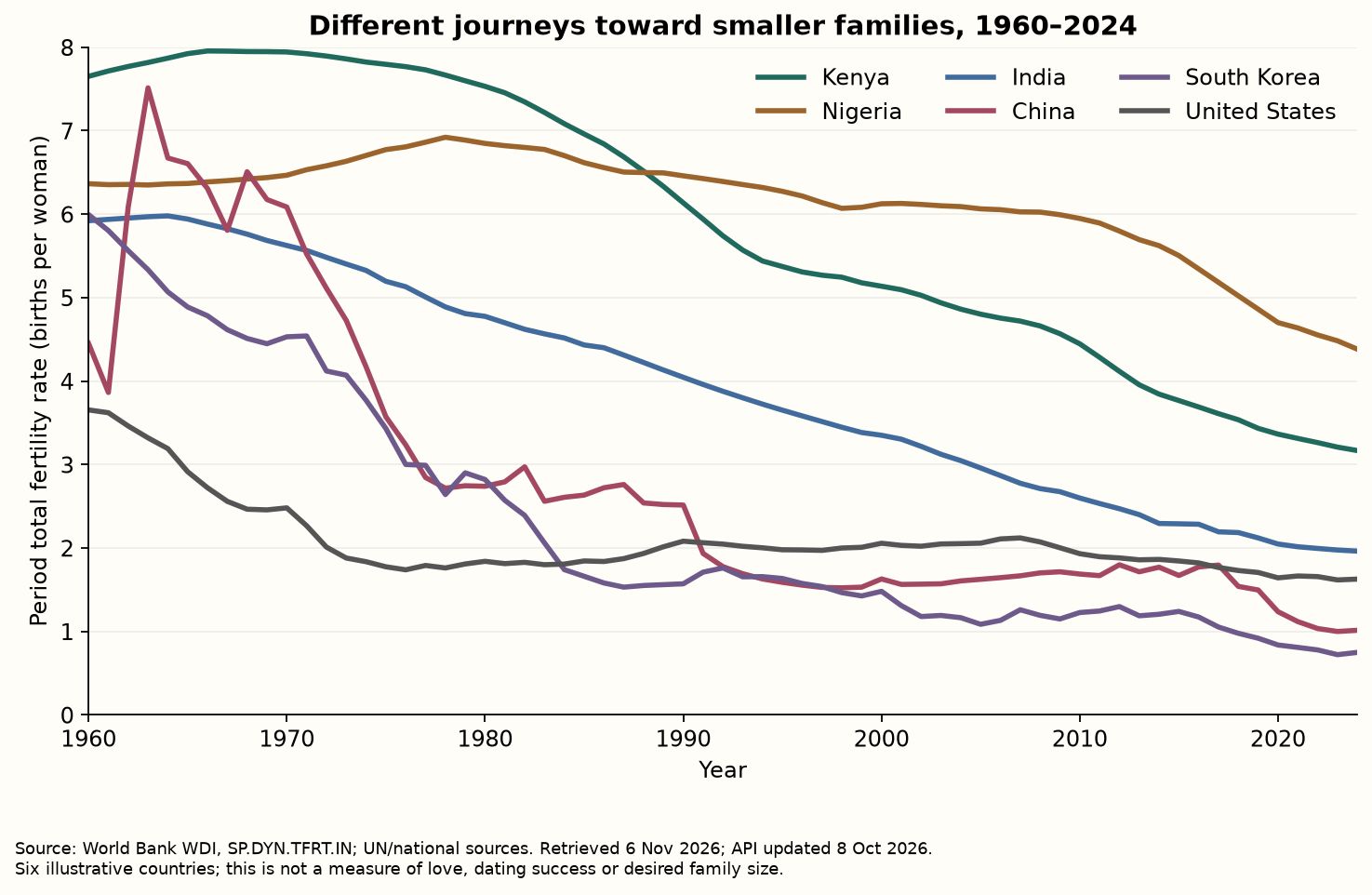
Six illustrative countries, 1960–2024. Period total fertility rate uses current age-specific birth rates; it is not completed family size or a romance score. Source: World Bank WDI, SP.DYN.TFRT.IN; UN/national sources. Retrieved 6 Nov 2026; API updated 8 Oct 2026.
Data source · Original chart; underlying World Bank data CC BY 4.0 · Open full-size visualization

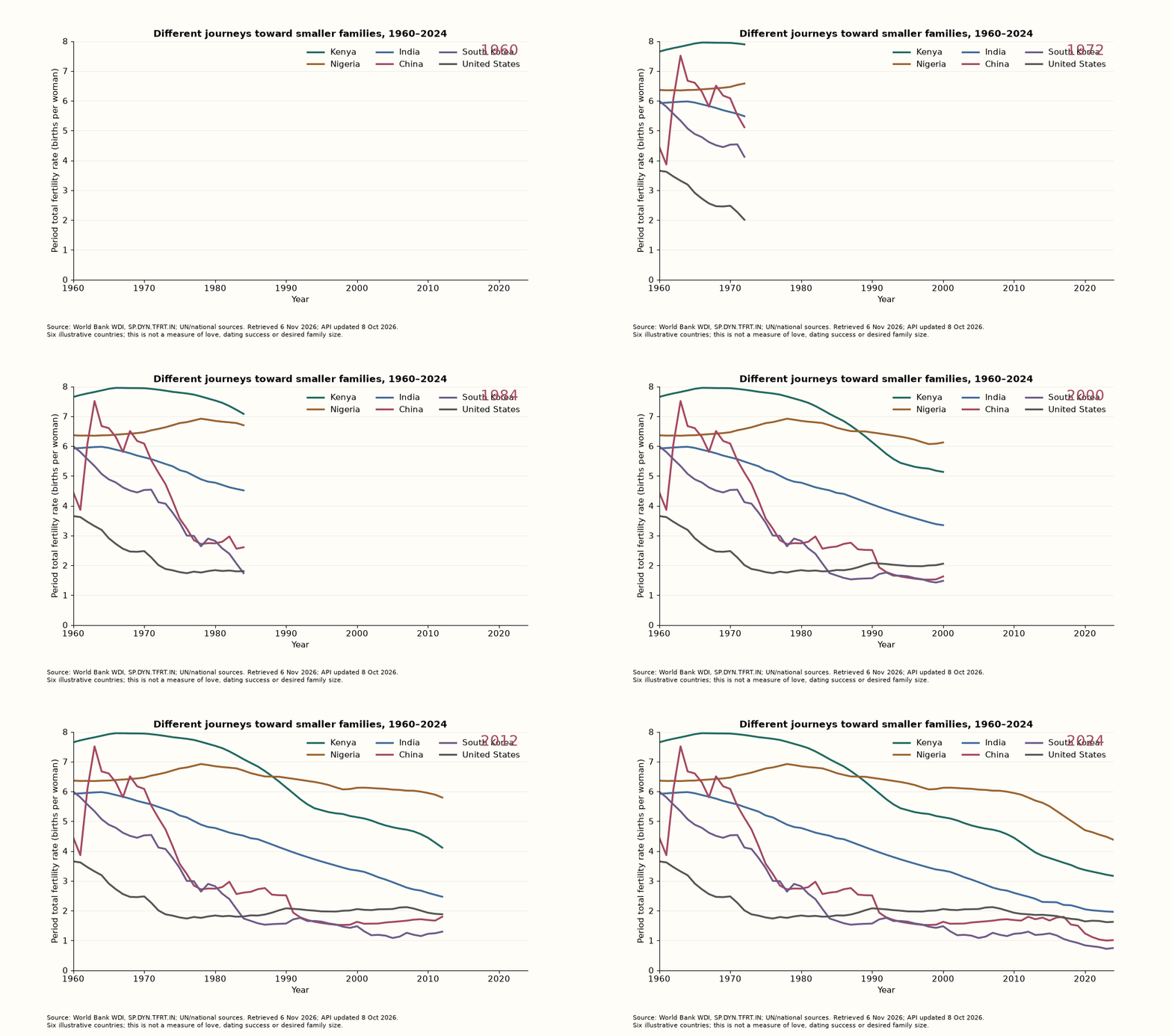
Animated historical reveal, 1960–2024; no future values are projected. The static chart above contains the full information. Source: World Bank WDI, SP.DYN.TFRT.IN; UN/national sources. Retrieved 6 Nov 2026; API updated 8 Oct 2026.
Data source · Original chart; underlying World Bank data CC BY 4.0 · Open full-size visualization
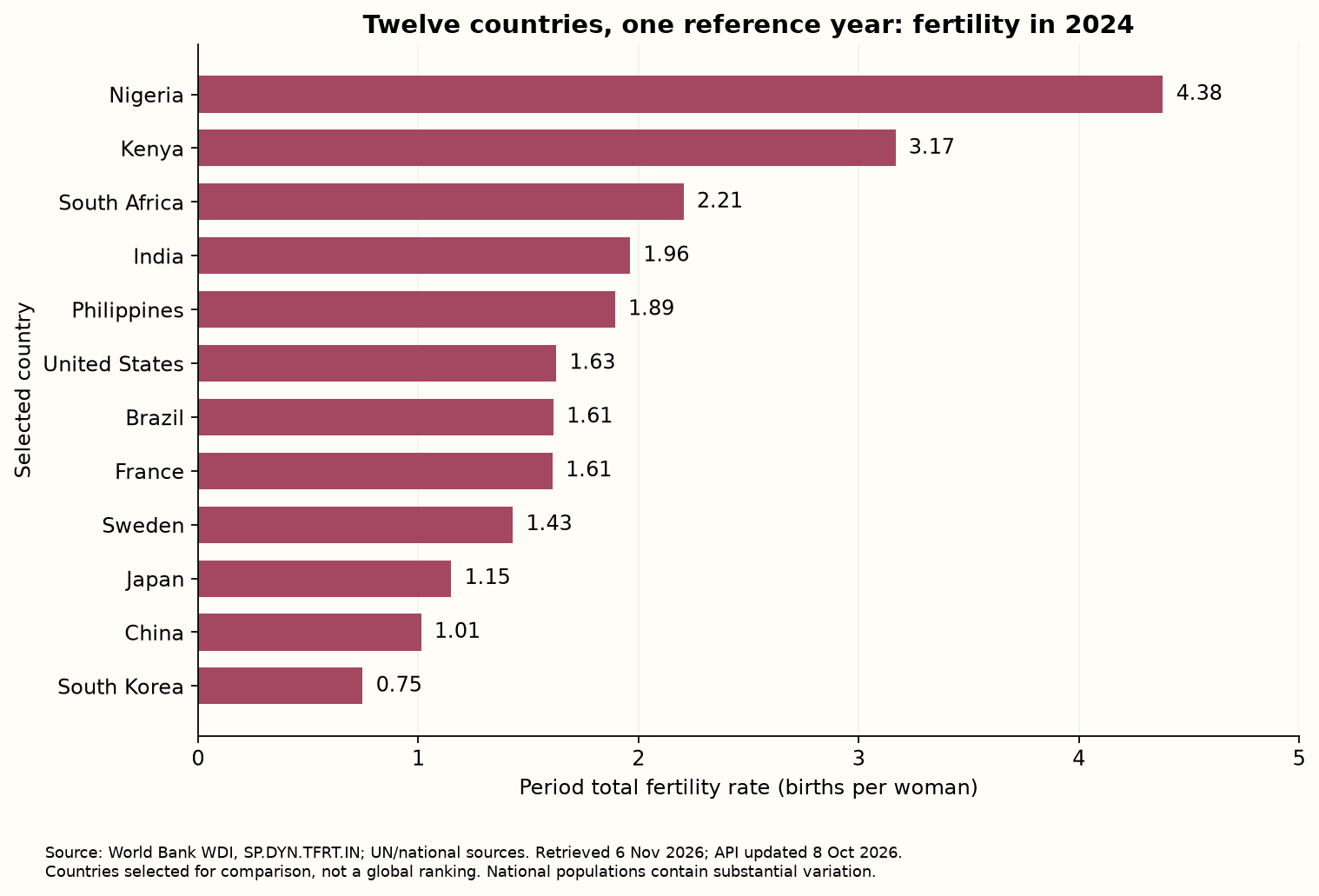
The historical curves belong to six selected countries. They are not a representative sample of humanity, and none is a line of romantic happiness. The twelve-country comparison below uses a common reference year, 2024, so that unlike periods are not casually presented as a single present. Estimates can be revised; a chart retrieved in 2026 still contains observations from the years printed on its axis.

Same-year comparison: 2024, not a claim about current 2026 rates. Values rounded to two decimals. Source: World Bank WDI, SP.DYN.TFRT.IN; UN/national sources. Retrieved 6 Nov 2026; API updated 8 Oct 2026.
Data source · Original chart; underlying World Bank data CC BY 4.0 · Open full-size visualization
The first threshold is sometimes a front door
Before the question of sharing a life comes the question of where to put it. A home supplies privacy, proximity and the possibility of planning. Yet sharing a home, leaving one's parents and getting married happen in different orders across societies. Living with family can be a valued arrangement, a financial necessity, or both.
Eurostat estimates that young people in the EU left their parental household at an average age of 26.2 in 2024, with substantial national differences. It also reports housing-cost overburden among young people: the measure concerns households spending at least 40% of disposable income on housing. Neither indicator is a dating-success rate. A person can have a relationship while living with parents; someone living independently can be painfully isolated. Eurostat, residential independence and housing costs.
A study of urban China in 2000–05 used an instrumental-variable design to examine house prices and first-marriage entry, finding that higher prices reduced entry under its identification assumptions. It is stronger evidence than simply noticing that expensive cities have later marriages, but it remains a result from a particular period and urban setting. It cannot describe every Chinese household today. Wrenn, Yi and Zhang, 2019.

Joe Mabel's photo of a residential street in Yanaka, Tokyo, taken 14 November 2014. Illustrative city-living image, not documentation of a particular housing market. CC BY-SA 3.0.
Photograph source · CC BY-SA 3.0

For a newcomer, the useful question is whether a prospective partner's housing expectations can be discussed. Must a home be owned before marriage? Would renting be acceptable? Is privacy available? Is living near parents a source of support, a condition of approval, or a limit on independence? The answers can differ between two families on the same street.
When income becomes a clock
Money does not purchase compatibility, but it changes the time available for looking and the risks attached to commitment. For someone on irregular shifts, meeting regularly may cost lost wages. For a salaried professional, it may mean negotiating long hours or a transfer. For a wealthy person, resources can ease logistics while creating other questions about trust, family assets and expectations. These are different constraints, not a ranking of whose affection is more sincere.
Economic shocks do not have a single effect on marriage. Autor, Dorn and Hanson linked manufacturing import competition in affected US labour markets to declines in employment and marriage-related outcomes. Their analysis concerns a specific historical shock; it is not evidence that every man with a low income is unwanted or that economic change explains every unmarried household. Autor, Dorn and Hanson, 2019.
There is a counterpoint from France. A study of changes in job protection found that greater insecurity led some women to formalize existing cohabitation as marriage, consistent with risk sharing, without increasing partnership formation overall. In one setting, uncertainty can delay marriage; in another, it can make its protections more attractive. The effect depends on the institution and the people already involved. Lepinteur, Marriage as Insurance.
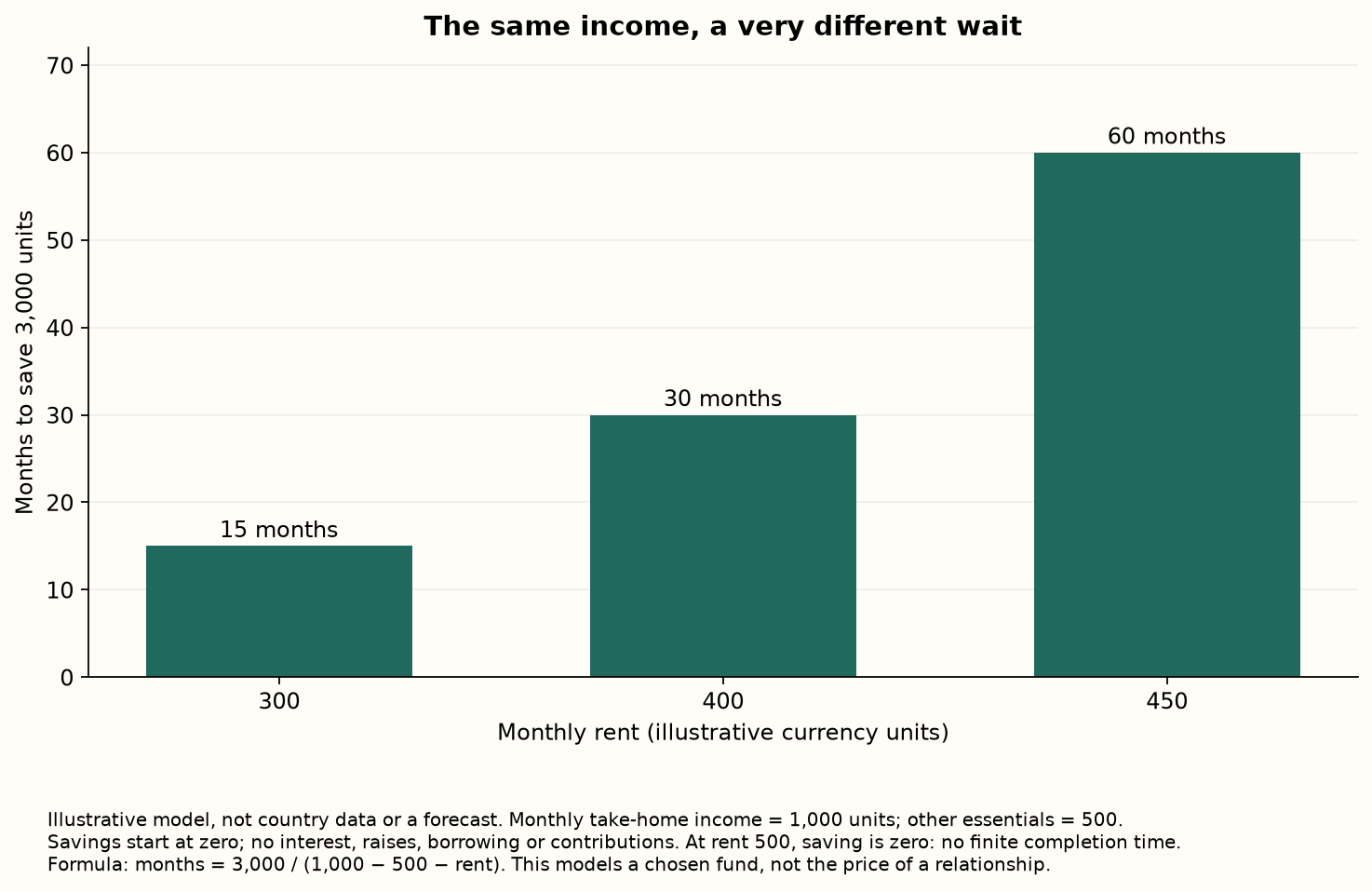
Here is a deliberately simple illustration. Take monthly income of 1,000 currency units, other essentials of 500, a chosen wedding or household fund of 3,000, and no starting savings. At rent of 300, saving takes 15 months; at 400, 30 months; at 450, 60 months. At rent of 500 there is no monthly surplus, so the target cannot be reached from this income stream under the assumptions. There are no raises, interest, contributions or loans in the model. These are not typical prices in any country. The model describes a financial threshold, not the cost of deserving love.

Illustrative affordability stress test. At rent 500 there is no monthly surplus and no finite savings time. All amounts are hypothetical currency units; no country or household is represented.
Illustrative Pawanax calculation; all assumptions are stated in the surrounding text. Open full-size chart.
The price at the wedding gate
The phrase “high bride prices” contains several institutions that should not be confused. Bridewealth commonly flows from the groom's side to the bride's kin. Dowry generally flows from the bride's side toward the groom or the new household. Mahr, in Muslim marriage, is owed to the bride herself; it is not simply another name for a payment to her parents. Recipients, ownership and local practice matter as much as the amount. Anderson, comparative research on marriage transfers, Qur'an 4:4.
Families may understand a transfer as recognition, alliance, security or continuity. Critics may experience it as a barrier, a source of debt or an assertion of control. Those interpretations can exist within the same community. The questions are practical: who decides the amount, who keeps it, whether the couple can refuse, and whether repayment is demanded if the union ends.
Chinese research illustrates the need to inspect the evidence closely. Wan's study combines retrospective family reports with a large collection of brideprice-dispute judgments. Court cases can illuminate contested payments; they cannot supply a representative price tag for every wedding. A payment may increase in real terms while its burden relative to household income falls. Absolute price and affordability are different measures. Wan, Between Money and Intimacy.
In India, Chiplunkar and Weaver's analysis of more than 74,000 rural marriage histories documents major historical changes in dowry. Its evidence concerns particular marriage cohorts and rural settings, not a universal account of today's Indian courtship. In rural Mozambique, longitudinal research associated bridewealth marriages with lower divorce and different work patterns, without establishing that the transfer caused those outcomes. A localized study in the DRC found mixed associations with women's reported wellbeing, including a less favourable pattern where large payments came with repayment requirements. No single moral label can replace those institutional details. India study, Mozambique study, DRC study.

Wikilover90's photograph of a wedding ceremony in India, taken 12 October 2018. Illustrative ceremony image, not associated with a specific story or named couple. CC BY-SA 4.0.
Photograph source · CC BY-SA 4.0

For singles entering a family-involved marriage process, clarity about expectations is valuable early. A ceremony, a family transfer and a shared household are separate budgets. A beautiful celebration may be freely chosen; debt taken on to prevent humiliation is a different bargain.
The invisible negotiation: whose future gets smaller?
Courtship often presents preferences as personality: ambitious, traditional, independent, family-oriented. Later, those adjectives become a timetable. Who can accept a promotion? Who interrupts work for a sick relative? Who notices that the household has run out of food? Who has time left for affection?
India's 2024 Time Use Survey gives a concrete view of unequal care. Among people aged 15–59, 41% of women and 21.4% of men participated in unpaid caregiving during the diary day; among participants, women spent 140 minutes and men 74. These are participant averages, not time spent by every Indian adult, and caregiving differs from unpaid domestic services. A one-day diary does not establish why a particular person marries or remains single. It does show why the future division of work belongs in conversations about compatibility. India Ministry of Statistics, Time Use Survey 2024.
Education changes the negotiating landscape without dissolving every boundary. Research in India finds increasing marriage between women and less-educated husbands, while caste and socioeconomic sorting remain relevant. A diploma is not the same as income, inherited wealth or social status. People can cross an educational boundary while remaining within a familiar class world. Lin, Desai and Chen, 2020.
Men can encounter expectations of provisioning that leave little room to admit uncertainty. Women can encounter expectations that paid work will fit around care that remains theirs by default. Either person can also prefer a traditional division and find it fulfilling when it is freely chosen and workable. The difficulty comes when the same word—partnership—conceals incompatible promises.
The room with a thousand doors
The internet has changed access. A US study estimated that 39% of heterosexual couples meeting in 2017 had met online, compared with 2% in 1995. Its population and years matter: this was not the proportion of every country using dating apps, nor proof that an online beginning predicts a happy or unhappy ending. Rosenfeld, Thomas and Hausen, 2019.
For people with small local dating pools, unusual interests, disabilities or identities that are poorly accepted nearby, online contact can widen the imaginable world. It can also make each person appear replaceable. A profile becomes an unfinished comparison with another profile; a conversation becomes something to postpone until a supposedly better one arrives.
Choice overload is not a universal psychological law. A 2010 meta-analysis found an average effect near zero across its experiments, with considerable variation. A later review identified conditions under which large assortments are more difficult, including uncertainty about preferences and decision complexity. In dating experiments, larger sets of profiles have produced short-term overload and related responses. These findings do not establish that everyone should have fewer choices, or that naming preferred nationalities solves uncertainty. 2010 meta-analysis, 2015 meta-analysis, dating experiment.
Studies of relationship outcomes also disagree. A US survey of marriages beginning in 2005–12 found somewhat more favourable outcomes among online-met respondents, whereas a later study across 50 countries found less favourable average satisfaction and love among its online-met participants. Neither randomized people into meeting routes. Different samples, years and surviving relationships can produce different answers. The route to a first conversation is only one part of what follows. Cacioppo and colleagues, 2013, Kowal and colleagues, 2025.
For a new dater, an app is an introduction mechanism. Its apparent abundance is not evidence of abundant mutual compatibility. A manageable number of conversations, a clear account of intentions and opportunities to meet through recurring social activities are reasonable practices to try; they are not guarantees supplied by these studies.
Has Gen Z forgotten how to speak?
The accusation is easy to recognize: young people can compose a message but cannot bear a silence, sustain a conversation or risk an unedited introduction. It bundles different questions together. Social anxiety, conversational practice, friendship time, loneliness and social competence are not interchangeable measures.
A Norwegian longitudinal study followed a cohort from ages 10 to 18. Increased social-media use did not predict an overall decline in later parent-reported social skills, and it was associated with more offline friendship time; a socially anxious subgroup showed a different pattern. This is a qualified finding from one cohort, not a defence of every platform. It directly complicates the claim that digital contact inevitably destroys social ability. Steinsbekk and colleagues, 2024.
The World Health Organization's 2025 report estimates that about one in six people experienced loneliness across the evidence period 2014–23, with higher estimates among adolescents and young adults. Loneliness is the painful gap between desired and experienced connection. It is not simply being alone, being single, or having few dates. The global estimate does not identify a uniquely defective generation. WHO, social connection.
The practical challenge is to create settings where interaction can develop without every encounter becoming an audition. Friendship, shared work, sport, volunteering, religious communities and accessible public places can provide repeated contact. Their availability differs by money, time, transport, safety and local culture. Social confidence is not distributed independently of the opportunities to practise it.
“Moral decline” and the argument about freedom
Some readers see a loss of fidelity, patience, modesty, religious commitment and responsibility to family. Their concern is not answered by saying that every new freedom is automatically an improvement. Deception, exploitation and abandonment can cause real harm. A person seeking lifelong commitment may reasonably find a social setting difficult when intentions remain deliberately ambiguous.
Other readers see freedoms their parents did not have: to leave a damaging union, refuse a match, remain childfree, acknowledge same-sex love, or postpone marriage without accepting a relationship simply to avoid disgrace. They may regard fewer compelled marriages as progress even when the marriage rate falls. A stable union is not necessarily a safe or wanted union.
These views overlap more than the slogans suggest. Someone may favour religious marriage and insist on consent. Someone may prefer casual dating and reject dishonesty. The empirical questions concern behaviour and consequences: truthfulness, coercion, violence, responsibility, satisfaction and the ability to leave. There is no single worldwide “moral degradation” indicator that combines them into an objective score.
For a newcomer, the relevant task is to establish what a word means between the people using it. Exclusive, serious, traditional, open, faithful and family-oriented each require a conversation. Nationality, clothing, educational status or an app label cannot complete that conversation on another person's behalf.
The futures people want—and cannot always reach
Low fertility can include freely chosen smaller families, delayed births, difficulties finding a suitable partner, health constraints, economic barriers and changing age structure. It cannot tell us the contribution of each on its own. UNFPA's 2025 survey across 14 countries found that 39% of respondents said financial limitations had affected or would affect desired family size. This is survey evidence about those populations, not a census of everybody's motives. UNFPA, State of World Population 2025.
The opposite problem exists too. Kenya's 2022 DHS estimated a total fertility rate of 3.4 and a wanted rate of 2.9 under its survey method. That describes a population-level gap involving unintended fertility, not a fractional unwanted child in every household. Supporting reproductive choice includes the ability to avoid a pregnancy as well as the ability to pursue a wanted one. Kenya DHS 2022.
The Philippines' 2022 survey reported fertility of 1.9 for the preceding three-year period, while stated ideals were higher. Actual period births and the family size people say they would ideally like are distinct constructs. Across societies, housing, childcare, working hours and the sharing of care can affect how reachable a desired family feels. A baby bonus alone should not be treated as a demonstrated cure for every obstacle. Philippines NDHS 2022, OECD analysis of fertility and policy.
A world map for the person opening the door
The following are orientation points, not instructions for dating a nationality. They cover selected countries and settings for which evidence is available; they are not an exhaustive guide to every jurisdiction. The most useful map leaves room for the person standing in front of you.
- China: Family expectations, housing and marriage transfers may enter conversations, with major rural, urban and class differences. Its 2025 figures recorded 7.92 million births, but marriage registrations rebounded to about 6.76 million couples. Neither fact predicts an individual's wishes. Expect to clarify the role of parents, place of residence and plans for children rather than presume that demographic pressure means willingness to marry. NBS 2025, marriage registrations.
- Japan and South Korea: Their low fertility and strong historical association between formal marriage and births make the timing of work, housing and family formation relevant. In Korea, marriages and births increased in 2024 from the previous year, complicating a straight-line decline story. A new dater should establish whether the other person is seeking companionship, marriage or parenthood; those aims cannot be read from the national rate. Statistics Korea, 2024 marriages, OECD fertility analysis.
- India: State, religion, caste, class and urban–rural differences make a single dating script especially misleading. Family introductions and personal choice can coexist. Education does not eliminate other matching boundaries. Clarify who participates in the decision, whether refusal is possible, and what financial expectations exist. The national fertility estimate of 2.0 in NFHS-5 concealed substantial state variation. India health statistics, education and marriage study.
- The Philippines: Survey evidence distinguishes rural and urban fertility and reported ideals from achieved births. Those differences counsel against assuming that family aspirations are uniform. Ask about expectations concerning work, relatives and children directly; a population statistic is not a description of a prospective partner. PSA, 2022 fertility results.
- Kenya: Nairobi's dating settings do not represent every county or community. The 2022 DHS reported substantial urban–rural and county fertility variation. Customary marriage expectations also vary. A newcomer benefits from discussing family involvement and the intended form of union early, rather than treating one ceremony or payment practice as universal. Kenya DHS summary.
- Mozambique and the DRC: The research used here concerns particular rural or localized settings, not two entire nations. It shows why the conditions surrounding bridewealth—including repayment and women's control over decisions—matter. Ask what an institution means in that family; neither condemnation nor romantic celebration at a distance is enough. Mozambique, DRC.
- Nigeria and South Africa: Their different 2024 fertility rates in the chart demonstrate the danger of a single “African family” story. They do not establish differences in loyalty, gender attitudes or openness to dating. For orientation within either country, local community, faith, class, transport and safety conditions will be more informative than the continental label. World Bank indicator and country series.
- France, Sweden and other European settings: Marriage is not the only route to household or family formation. Eurostat reports that 41% of EU births occurred outside marriage in 2024, with wide country differences. Dating without immediate marriage plans need not mean refusing commitment; it may mean choosing another institutional form. Clarify the form instead of inferring the intention. Eurostat, Demography of Europe 2026.
- The United States: Online introductions are well documented, while class, religion and local labour markets create different experiences. Do not assume that an app's availability means that intentions are understood. The research on meeting route and later relationship outcomes is mixed, making direct conversations more useful than treating “online” or “offline” as a quality certificate. US meeting-route study.
- Mexico and Brazil: Mexico's official evidence documents cohabiting unions alongside marriage; Brazil's fertility appears in the comparative chart. Neither country stands for Latin America as a whole, and a low fertility rate supplies no licence to infer casualness or commitment. Where partnership and marriage are distinct possibilities, ask which future the other person means. INEGI, union status, World Bank fertility series.

Jpbowen's photograph of the marriage market at People's Park in Shanghai, taken 7 September 2013. Illustrative scene from the market; it does not identify the people pictured. CC BY-SA 4.0.
Photograph source · CC BY-SA 4.0

The missing places matter as much as the named ones. Middle Eastern and North African societies, Southeast Asia beyond these examples, Pacific communities, Indigenous populations and diasporas contain distinct institutions and lived experiences. A comparative feature can identify questions worth asking; it cannot replace local knowledge of law, language, community and individual preference.
Who disappears from the average?
Young heterosexual adults are not the whole romantic world. LGBTQ people may encounter different opportunities for finding one another and different risks of disclosure. Legal recognition, acceptance by relatives and access to chosen community cannot be assumed across borders. A German study of LGBTIA respondents illustrates how contact with family and friends and partnership status relate differently to loneliness; its targeted online sample should not be treated as a universal measure of queer life. Study of social connection in Germany.
Disabled people are also frequently written out of the imagined dating public. A small German interview study of young adults with physical or sensory disabilities documented relationships and sexual experience while identifying variation between groups. It challenges assumptions of asexuality without representing every disability or everyone's needs. Accessible venues, communication, transport, privacy and control over support are part of the environment in which connection becomes possible. Pösl and colleagues, 2017.
Older, widowed and divorced people may enter a dating scene with existing families, care obligations and histories they cannot reduce to a short profile. A parent may need reliability more than spontaneity. A childfree adult may want commitment without a reproductive project. People seeking consensual nonmonogamy need agreements understood by everyone involved; evidence about such relationships cannot establish the suitability of a particular household. These are different life arrangements, not lesser versions of a standard romance.

Ed6767's 1 November 2021 photograph, described on Commons as an elderly British couple in a park. Illustrative European public-space scene. CC BY-SA 4.0.
Photograph source · CC BY-SA 4.0

Migration adds distance between affection and practical life. A relationship across borders may involve language, money transfers, visits, separation from relatives and uncertain residence arrangements. Shared interest in moving does not establish shared expectations about work, children or dependence. A passport is neither a personality test nor a promise that a legal route exists.
Trust has become part of the infrastructure
The possibility of connection creates an opportunity for imitation. A convincing account can be a person, a performance, or a fraud. The FTC reports US losses of $298 million in 2025 to romance scams that originated on social media. Those are reported losses within a specified contact channel, not worldwide losses or the risk of any particular date. FTC, April 2026 data spotlight.
For newcomers, a sensible distinction is between emotional openness and immediate financial trust. Knowing someone's story does not verify it. Nor does caution require treating every stranger as an enemy. Public first meetings, gradual disclosure and independent checks are practices people can use while deciding whether trust is earned. They do not remove every risk, and responsibility for deception remains with the deceiver.
Safety is not an optional concern added to otherwise identical dating experiences. Anonymity, harassment, coercion, dependence and the ability to leave can change what a possible relationship costs someone. Research among Australian platform users documents serious experiences of dating-facilitated harassment and violence, but its selected user sample and overlapping categories must not be translated into a probability per date. Australian Institute of Criminology.
Eighteen measures that make a better map
For readers trying to understand a dating environment, these are useful lenses rather than a universal compatibility score. Several measure institutions or opportunities; others require direct conversation or suitable survey evidence. They should not be added into a single global ranking.
- Housing affordability: the share of disposable income required for housing, alongside privacy and available alternatives.
- Income stability: predictable earnings and exposure to job loss, not simply salary or occupation.
- Time availability: working hours, commuting, care and the realistic opportunity for repeated meetings.
- Meeting channels: introductions through friends, family, community, work or online platforms, with clear survey populations.
- Partnership intentions: companionship, exclusivity, cohabitation, marriage and parenting considered separately.
- Family influence: the roles of approval, practical support, introductions and the freedom to refuse.
- Marriage transfers: direction, size relative to resources, control of the payment and any repayment condition.
- Ceremony costs and debt: chosen spending separated from household setup and social pressure.
- Education and social sorting: qualifications distinguished from class, caste, income and inherited wealth.
- Care distribution: paid and unpaid work, including who has to notice, plan and interrupt other activities.
- Age and life stage: first partnership, remarriage, existing children, eldercare and the time horizon someone wants.
- Fertility and intentions: period birth rates distinguished from wanted births, preferences and reproductive health access.
- Loneliness and friendship: desired connection, supportive networks and actual experience beyond romantic status.
- Trust and safety: truthful disclosure, harassment, coercion, fraud and the ability to leave.
- Values and faith: meanings attached to sex, fidelity, commitment, family and responsibility.
- Inclusion and access: disability access, acceptance of identity, privacy and recognition of different household forms.
- Mobility: distance, transport, migration constraints, language and where a shared life could realistically be lived.
- Relationship wellbeing: satisfaction, respect, conflict resolution and agency, rather than duration alone.
The purpose of measuring is to see more clearly, not to reduce a human being to an application form. Some of the most important answers arrive slowly, in how someone behaves when plans fail or when another person's wishes differ from their own.
Three possible futures, 2030 to 2040
The following are conditional scenarios, not probability-weighted forecasts. The evidence does not justify a single prediction for “world dating,” and no scenario assigns a future fertility rate. The household savings calculation is an illustration of one mechanism, not a calibrated model of global behaviour.
A future of postponed lives. If secure housing, predictable work and affordable care remain out of reach, more people may defer independent households or formal commitments, while some continue relationships in other forms. By 2030 the signal would be a widening gap between stated family intentions and achievable plans, alongside persistent housing burdens. By 2040, smaller cohorts entering parenthood could keep birth counts subdued even where period fertility recovers somewhat. The pathway would weaken if material conditions improve or institutions allow people to build secure lives through different household forms. UN World Population Prospects, projection framework.
A future of negotiated intimacy. If platforms offer more useful introductions, communities provide repeated opportunities to meet, and partners negotiate work and care more fairly, greater choice could coexist with more sustainable commitment. The result need not be a return to one historical marriage pattern. By 2030, relevant signs would include narrower care gaps and better alignment between intentions and outcomes; by 2040, a wider range of household forms might be institutionally ordinary in some societies. This remains a possibility, not evidence that any policy package guarantees it.
A future of intimacy divided by resources. If time, safe housing, mobility, childcare and trusted networks remain unevenly distributed, dating could become more unequal even while the same apps are available to everyone. Wealthier people might be better able to buy time and reduce practical friction, without gaining immunity to loneliness or betrayal. New AI tools could assist communication or verification, while also making impersonation cheaper. The balance depends on design, incentives and behaviour; the existence of a technology does not establish its social outcome.
Across these paths, the useful signals are housing burdens, employment security, time spent in care, reported loneliness, routes to meeting, safety experiences, relationship satisfaction, and the gap between wanted and achieved family plans. A fall in marriages alone would not tell us which future had arrived. Nor would a rise in births.

Paul Jacobson's 2014 photo of two people walking at Umhlanga near Durban; the Commons source identifies them as a couple. Illustrative African public-space scene, not Nairobi. CC BY-SA 3.0.
Photograph source · CC BY-SA 3.0

The world is still making introductions
For someone entering dating, the practical expectation is variation. There will be people looking for a future, people trying to understand what they want, people seeking something temporary and people whose intentions change. Clear intentions help; compatibility still has to be discovered. A country guide can explain an institution. It cannot tell you whether a particular person will be kind.
The older world did not offer everybody security, and the newer one does not offer everybody freedom in equal measure. Families can shelter or constrain. Platforms can introduce or exhaust. Independence can enlarge a life while making companionship harder to organize. Commitment can be a gift, provided that the people making it have room to choose.
Perhaps the most hopeful fact about romance is also the least convenient for a chart: it requires attention to someone who will never be entirely predictable. Somewhere, after all the statistics have been read, a message will be answered. A conversation will last longer than expected. Someone will discover that the future need not be faced alone—and someone else will discover that a chosen life alone can be whole. The world has not finished learning how to love. It is still deciding what conditions love deserves.
Continue exploring
Evidence reviewed 6 November 2026. Country examples illustrate variation; study years and populations are stated beside claims. Future scenarios and the savings model are conditional illustrations.
Cover image: Carlos Ebert's photo of people at a cafe in São Paulo, Brazil, taken 15 October 2015. The people are not identified; the scene is illustrative of shared social life. CC BY 2.0. Original photograph; licence. Photographs used without editing. Charts created by Pawanax Editorial; World Bank data attribution retained.

About the author

Pawanax Editorial
Pawanax Editorial examines technology, political risk and trade through their consequences for Kenya and Africa. Articles distinguish reported facts, analysis and hypothetical scenarios.
Related articles

World Ledger 2026
The Hold Was Not the Same Everywhere
Retrospective written 16 October 2026; focus month: April 2026. In April 2026 four central banks reached the same verdict, and a careless reader of the headlines could have concluded that the world's monetary authorities had settled into a single, synchro...

Mr. Derrick Macharia
October 16, 2026 · 5 min read

Business
A comprehensive Analysis of Kenya's Economy
There is a comforting myth many developing countries tell themselves: “What happens in Washington is far away. We have our own problems.” Kenya, like most emerging economies, knows this is not true — but still underestimates how deeply American fiscal de...
Mr. Derrick Macharia
December 13, 2025 · 5 min read

Business
How the World Quietly Crossed the Point of No Return
The Event Horizon of 2025 History rarely announces itself. It does not arrive with trumpets, declarations, or a single catastrophic day that future textbooks can easily circle in red. Instead, it moves through infrastructure, balance sheets, food systems...
Mr. Derrick Macharia
January 10, 2026 · 5 min read
Stay in the loop
Get new articles on healthcare AI and African health systems.
Healthcare AI insights. Unsubscribe anytime.